
Feedback on the first SLICES-FR Summer School
Quentin Guilloteau
2025-07-08
The first SLICES-FR Summer School took place in Lyon, France from the 7th to the 11th of July. This was the perfect occasion for the community to clarify their needs in terms of experiments and for the board of SLICES-FR to share their vision and answer questions.
Kairns and SLICES
Most of the projects of Kairns do rely heavily on testbeds such as Grid'5000 (a "precursor platform" to SLICES). For instance, the validation of Batsim used Grid'5000 to deploy an instance of OAR to replay traces in "real life" and to compare it to the results in simulation.
The work done by the members of the Kairns collective is largely supported by platforms such as Grid'5000. Grid'5000 as a project is reaching "end-of-life". As the platform it is partly being "integrated" into SLICES-FR, we had our shares of concerns considering the unclear future of the platform, and thus our work.
Presentation on Functional Package Managers
During the week, Kairns was represented by Olivier RICHARD who presented Functional Package Managers (e.g., Nix, Guix) and how they can participate to the reproducibility of experiments on SLICES. Olivier also presented NixOS-Compose, and was brave enough to do a quick live demonstration! (which of course worked flawlessly but slightly too slow to be completed !!)
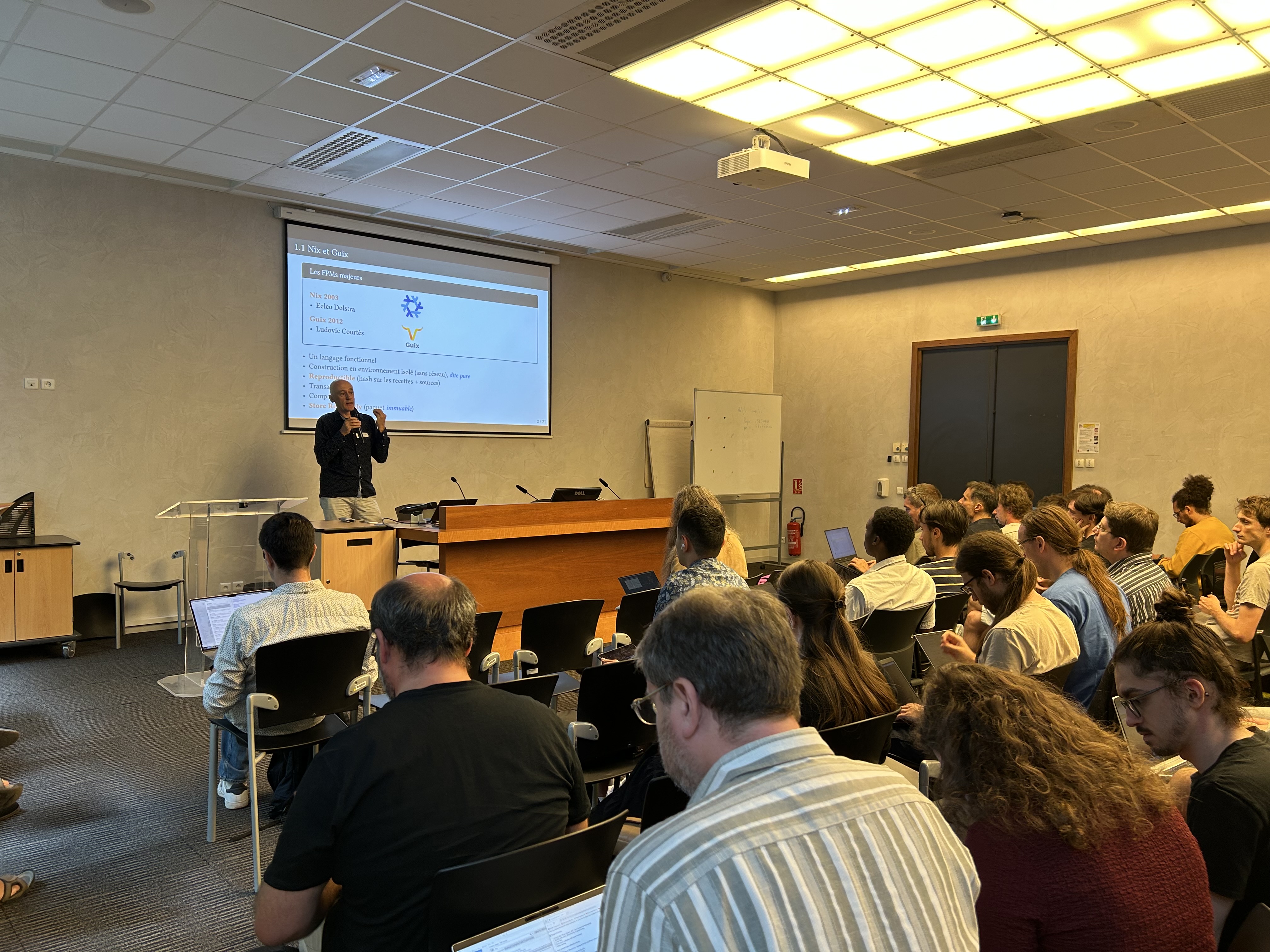
During the week, Olivier was not the only one mentioning Nix in their slides! Volodia PAROL-GUARINO (PhD student in Rennes) presented the work from his PhD on "Auction-based Placement of Functions in the Fog on a Large-Scale Testbed", and he is using NixOS to generate reproducible virtual machines images that he then deploys on Grid'5000. Volodia also expressed the need for better/native support of Nix on Grid'5000 (and in-fine SLICES(-FR)).
Some people also came to us during the breaks, with questions and interrogations about Nix and NixOS-Compose! This shows at least some interest of the various communities of SLICES on these questions. Similarly, the technical teams of SLICES-FR (from the ex-Grid'5000 part) and ABACA (INRIA's production computing platform) were quite supportive of letting us propose a solution to support Nix on the platforms, which might be, in the end, supported/managed by them (Stay tuned for the future blog posts !).
Panel Discussion on Experimentation, Complexities, and Multiculturalism
Olivier was also the chair of a panel discussion on the topic of "Experimentations: between Complexity and Multiculturalism". The invited speakers were: Georges Da Costa (HPC/Cloud), Remous-Aris Koutsiamanis (IoT), Laurent Pouilloux (HPC), and Damien Saucez (Network).
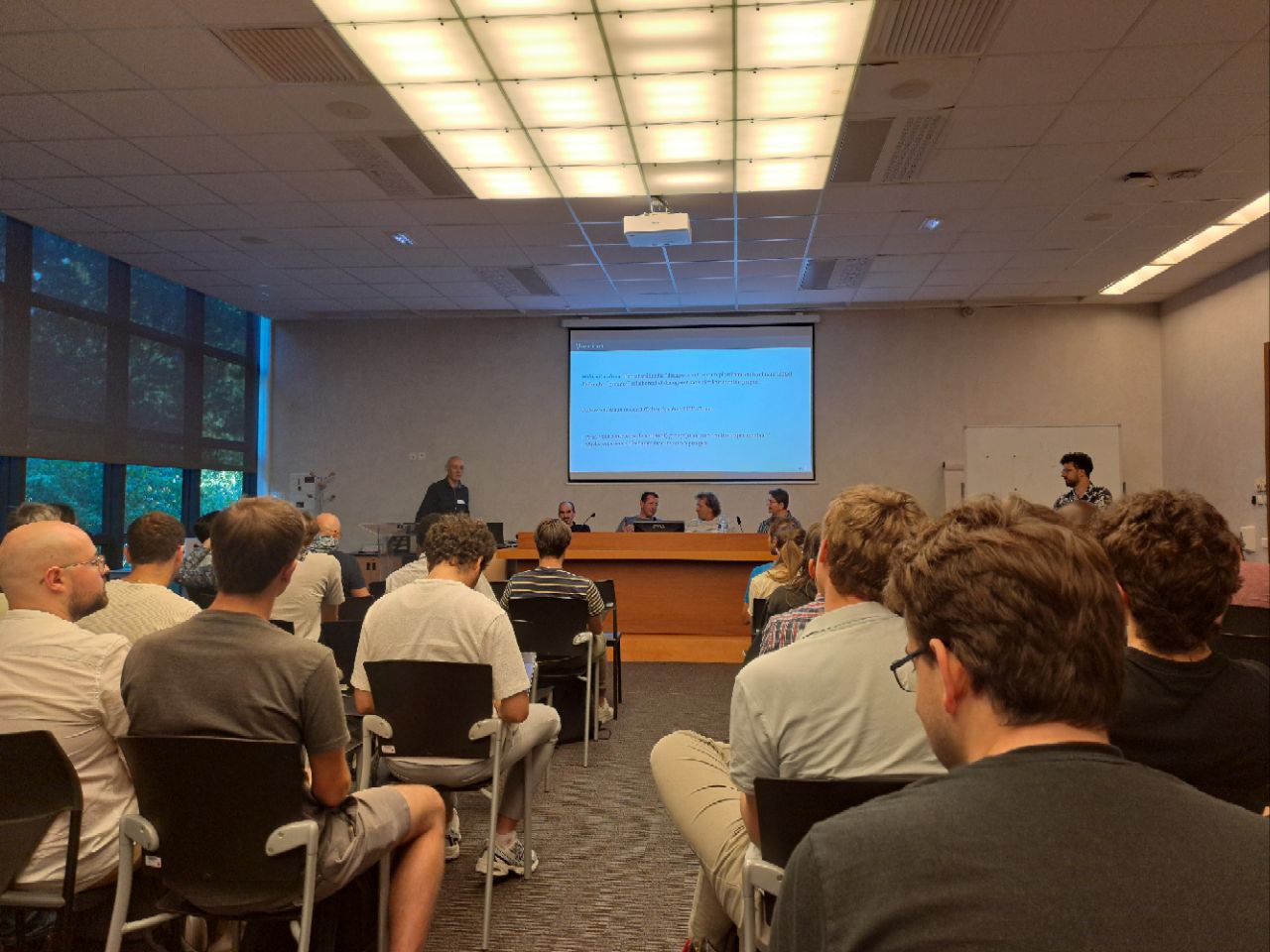
The panel discussion first started with a round of short presentations by the speakers about their background in terms of experiments and their links with SLICES. Then Olivier fired off the questions.
What follows is a summary of the discussions.
Complexities
The speakers identified complexity at several level within the scientific and experimental process.
Researchers should try to protect themselves from the complexity, for instance by not relying on software that "promise" too much, and then will get them stuck using it. There is also a double-edge sword to the tools which try to hide too much of the complexity, as when they break, the users are then stunt by the true complexity and now "stuck".
This is specially true for SLICES, as there is a great heterogenity in the technical skills from the users. Some users might want to interact with SLICES via GUI from their browser (e.g., Jupyter Notebooks), while others might want to use SSH to connect to the frontends of the zones. The mental images of what the platform looks like might be very different based on how one choses to interact with it. This seems similar to programming in assembly, C, or Python, where using only assembly you will need to deal with 100% of the complexity. C gives you a wrapper on assembly, with some help from the compiler, but you will have to deal with all the memory allocations. Python on the other hand, hides everything from you, and not knowing which operations might perform a copy and thus a memory allocation will come later to bite you.
SLICES will propose several levels of abstractions (think assembly, C, Python) to interact with the platform. It will be the responsability of the users to educate themselves to understand the hidden operations, and thus complexity, that those abstractions protect them from.
Let us hope that, in a fast paced academia where one needs to publish as fast and as frequently as possible, people will take the time to get familiar with the complexity rather than using the productive high level tools "brainlessly". Let's not forget that SLICES will most likely impact the experimental practices of most of the europeen researchers on distributed computing.
From the pov of the platform, it will also be challenging to deal with all the different backgrounds of the users, and to propose the appropriate levels of abstractions to allow scientists to easily express various and complex experiments while not losing in expressivity and features (compared to the "precursor platforms").
Community and Multiculturalism
The diversity in the community is also reflected in the difference of terminology when dicussion what is an Experiment. What came out of the discussion is that people from the different sub-communities of SLICES(-FR) might need to meet and discuss more often to understand the motivations and needs, in terms of experiments, of each others. This could take the form of monthly informal small presentation session in the different zones of SLICES-FR. For example, all the SLICES-FR community of Lyon meet once a month, with 3 or 4 small presentation of the experiments of users (master students, PhD students, postdocs, or permanent researchers), and then followed by informal discussion (and maybe then drinks).
One crucial point is to not force the sub-communities to change their methods in order to integrate in a higher/bigger community (and this links back to the previous section on Complexities) It is more "important" to create bridges between the sub-communities and platforms rather than trying to unify everything now. SLICES should be a framework for the organic "merging" of the sub-communities (as it was for the creation of Grid'5000). But from the slides of the SLICES board's presentation it seems that the dream goal of SLICES is to seemlessly experiment on the Continuum. The question is: how many users of SLICES do need really to experiment on the continuum? and is this quest of experimenting on the continuum not degrading the user experience of the others users? For example, an experiment on the continuum (IoTLab and Grid'5000) is possible without an all-integrated system, but by dealing a bit with the complexity of the platforms.
A point was raised about the integration of the integration of the "younger generation". This should also be focus point of SLICES if it wants to "keep existing" (remember that the end-of-life of SLICES is scheduled for 2042!). This integration could be done via hackathons (preferably done in person) with the master students, PhD students, postdocs working on problematics of their communities but also on transversal problematics. Teachers should also not shy away from introducing SLICES during their classes and practical sessions.
Overall Feedback from the Summer School
This summer school was needed. First, for the community (and thus sub-communities) to meet each others. But also for the community to meet the leading people behind SLICES-FR, and for these leading people to express their vision for the platform.
Reading between the lines
What comes out is that there are in fact two levels at what is presented during the presentations of the leaders of SLICES(-FR). The first level is the "marketing level" which might go well during the meetings at the european level, but that seems too disconnected from the actual reality of the day-to-day research when presented to researchers. The second level is only available if you go talk to the leading people face to face. Then the claims are a bit more nuanced and down to earth (let's not forget that those people are still scientists!). What is frustrating is to not be able to get to this second reading of the marketing speech, or to not know that there is actually a less official/marketing speech.
In summary, the people leading SLICES(-FR) are not completely disconnected from the needs of the different (sub-)communities, and they do not mean "bad". From the informal discussions, SLICES will actually be built by the users (and supported by the techincal team) for the users, bringing their their solutions to their own needs/problems (e.g., the support of Nix in SLICES). This is the main idea of the (in)famous "blueprints".
Engineers, engineers, engineers, and engineers
No platform can survive without a techincal team of engineers. It was a bit unclear during this week, how the engineering workforce will be managed during the lifetime of SLICES. As SLICES should run at least until 2042, only having short fixed-term contracts (in France it is maximum 6 years in the public sector (but 5 years in practice)) might not be a viable strategy for the good handoff of the knowledge of the platform.
(Text reviewed by Olivier RICHARD.)